martes, 22 de noviembre de 2011

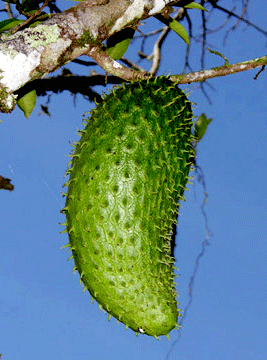
GRAVIOLA: Anona muricata L.


Graviola is a small tree 8 to 10 m high, cultivated in almost all tropical America. It has a fruits from 15 to 20 cm long.

Actually its importance lies in the possibility of being used to relieve some discomfort because their leaves are substances such as acetogenins, which have an activity similar to that of products used in chemotherapy (eg adriamycin) with the quality of not presenting their side effects.

STUDIES
Complement Graviola, several studies indicate that consumption may be beneficial:

  • A study conducted at Purdue University in California, demonstrated that the acetogenins can selectively inhibit the growth of cancer cells and also inhibit the growth of tumor cells resistant to doxorubicin (chemotherapeutic drug), respecting the integrity of cells healthy tissue. In another study conducted by scientists at the University, it was demonstrated that the acetogenins of soursop (graviola) are extremely powerful to have an ED50 (lethal dose 50) of up to 10 to 9 micrograms per milliliter, resulting to have about 10,000 times the power of adriamycin.
  • Studies from 1998 to 2000 by McLaughlin and Chih HW, Chui HF have shown that acetogenins are inhibitors of complex I of oxidative ng fosforilaci chain thus block the formation of ATP energy needed by the cancer cell that puts in operating your pump P-glycoprotein-mediated, that lets you stay active. Acetogenins, also inhibit the ubiquinone oxidase, NADH-dependent enzyme is peculiar in the plasma membrane of the cancer cell. McLaughlin did his research and Bullatacinone Bullatacin acetogenins.

READ MORE

Cats Claw

Cat's Claw is a plant native to the Peruvian jungle, is a liana of the family Rubiaceae, is known by that name by the thorns, such the claws of cats. In Peru there are approximately sixty different plants that live in the three regions, which is known as cat's claw, however, only one of these, identified as Uncaria tomentosa is the bearer of the main active ingredients beneficial.

BENEFICIAL EFFECTS IN OUR BODIES

It is used to treat asthma, recovery from childbirth and wound healing, pain in the joints, stomach problems, tumors, birth control, as a tonic to prevent disease, treat bone pain and kidney cleanse, irregularities in the menstrual cycle, acne, fungal, wound healing and nerve pain.
Relieves discomfort of urinary tract inflammation, cirrhosis, gonorrhea and diarrhea.


READ MORE


LOOFAH

The Luffa is a natural sponge, with fine fibers, resistant, elastic, and soft when wet.
The sponge is used as exfoliating Lufa, where has all the advantages over their competitors made from synthetic materials, and sponges off the sea.
This applies especially when it is becoming aware that it is preferable to use products caring environment and that can be obtained easily and economically.

Exfoliation of the body:
The LUF exfoliating products for the body should be applied as follows:
It should exfoliate with LUF ( gloves loofah or oval body sponge) when we are in the shower or bathtub because the skin is already wet.
There's always that rubbing the body to rise to the heart with circular movements to help blood circulation.
Face Exfoliation :
As for the exfoliation of the face, there is a method for doing so.
Clean the face with a LUF facial sponge , then mix one spoon of honey with exfoliating facial rosehip. Rub the mixture gently on the face and then rinse with lukewarm water.


READ MORE


Amazonian Resins: Dragon's blood - Copaiba Oil

Resins and latex extracted from Amazon trees that have proven medicinal healing actions, antivirals, remove inflammations.

Dragon's Blood (Croton Lechleri)
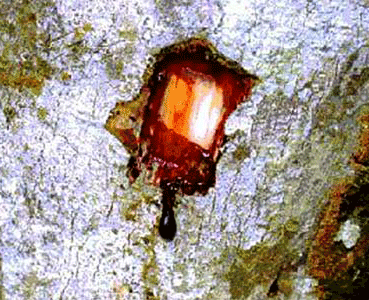
Latex Amazonian tree of the genus Croton, especially C. lechleri, is called Dragon's blood or GRADO'S blood, it is used in traditional medicine since the time of ancient Amazonian tribes and in modern times it has been studied and has proven their medicinal properties as healer, thanks to its alkaloid content of Taspinar, and as antiviral, for the content of the principle SP-303, a Proanthocyanidins oligomers antiviral action.

Copaiba Oil(Copaifera Paupera)
Copaiba oil is obtained from the copaiba tree, long used by natives in the Amazon Jungle, by distillation. This natural oil is indicated for treatments of diseases such as bronchitis, (antiseptic and as expectorant) and inflammations. Copaiba oil contains the active copaiba acid, which is eliminated by the kidneys and acts as an antiseptic and anti-inflammatory of the mucous genital and urinary system. It is very effective on gonorrhea - not


READ MORE

Essential Oils: Eucalyptus - Molle

Molle and eucalyptus essential Andean oils , they are used in all respiratory problems, they also serve as powerful antibiotics and anti-inflammatory skin and muscle…

Molle Essential oil (Schinus Molle)
Our molle essential oil is extracted from the leaves and fruits of the "Peruvian pink pepper tree" or "Andean Molle", these trees grow wild all along the Andes ..
The molle plant has a long history of use as an astringent, depurative, diuretic, balsamic, such as eye drops, diuretic, rinses, pesticides, depurative, tonic, antiviral. There are many documents stating its use by Amazonian indigenous people.
Molle oil is used externally as an antiseptic for fractures and for topical use.
A photochemical analysis made on molle reveals that the plant contains tannins, alkaloids, flavonoids, saponins, steroids, sterols, terpenes, gums, resins and essential oils. The essential oil is mainly in the leaves, bark and fruits.

Eucalyptus essential Oil (Eucalyptus Globulus)
The eucalyptus essential oil of Inkanatural is extracted from leaves of trees growing wild in the Peruvian Andes, trees are not cultivated, they live wildly in the mountains - more than 3000 meters above sea level - .
This essential oil is a potent antiviral and bactericidal, it relieves from problems of cold weathers. Eucalyptus was a natural protector during influenza epidemics. Spraying a solution of 2% of eucalyptus oil kills between 70 and 100% of staphylococcus in the air, - Jean Valne , The Practice of Aromatherapy, 1990 - It is antiseptic and tissue regenerator. It is also used in massages to relieve from rheumatic pains on muscles.

READ MORE

Sacha Inchi Oil

The Amazonian vegetable oil rich in omega 3
Sacha inchi seed is grown wildly in the Peruvian Amazon, it was known by native Peruvians thousands of years ago. The Incas represented sacha inchi seed in their ceramics. This seed is also known as the inca peanut.

Scientific researches have found that Sacha inchi is one of the best oilseeds by its composition and high nutritional profile:
  1. Its oil is high in fatty acids: omega 3 (over 48%), omega 6 (36%) and omega 9 (8%)
  2. Sacha inchi oil has a high digestibility (over 96%)
  3. It contains antioxidants vitamin A and vitamin E alpha-tocopherol
  4. Over 60% of the kernel is full of high quality proteins (99% digestible)
  5. Sacha inchi oil is very rich in essential and non-essential amino acids, in sufficient quantities to improve the general human health.
Sacha Inchi Oil: Internal Use
The two fatty acids Alpha Linolenic Linoleic Omega-3 and Omega-6 (84%), of its composition are very important for controlling and reducing the cholesterol levels. They also helps to form the nerve tissue (myelination) , eye tissues and the structure of cell membranes. These fatty acids are also involved in other important functions in a direct way: the regulation of blood pressure, immune functions.
This facts made Sacha inchi oil and important product in the well keeping of the health as a preventive way to have a healthier life.

Sacha Inchi Oil: External Use
Its components (unsaturated fatty acids and vitamins) are also widely used in the cosmetics industry. Sacha inch oil restructure and protects the skin, hair and nails, limiting dehydration, strengthening and rebuilding its natural barriers.

Its external use is indicated for sensitive skin, dry, including inflammation and irritation, and for dry or damaged hair. Vitamin E is an active component for regeneration and unsaturated fatty acids nourish, treat and prevent the problems of skin and hair.

READ MORE

Stevia

The natural sweetener, alternative to saccharose and artificial sweeteners. Its high sweetening power and its cero calories make it a suitable complement for foods, in diabetic problems and in weight loss diets.

This plant, known as stevia, is widely used nowadays. Japanese, Americans and many other consumers are using this plant as an alternative sweetener in diabetic problems and in weight loss diets, thanks to its absence of calories.

Steve plant:

Stevia plants grow normally between 40 to 60 cm, it flourishes in august and September. Stevia plants are cultivated nowadays in Peru, Argentine, Brazil, Uruguay, Paraguay and in some other countries. Its flowers are white; its root grows near the surface. Stevia leaves have between 30 to 45 times sacharose’s sweetening power.
Stevia leaves are dried to be pulverized, taking off the nerves of the leaves to eliminate its bitterness. It can be then used as a sweetening powder or in liquid form.

Stevia History

Stevia has been known for centuries as a sweet plant by the Guaraní tribes of Paraguay and Brazil. They used Stevia, called ka'a he'ê ("sweet herb"), for its several benefits, including its use as a sweetener and for medical purposes.
In 1931 the French chemists Bridel and Lavieille extracted from the leaves of this plant a white and crystalline element which they named “stevioside”, having 300 times more sweetening power than normal cane sugar. In 1952, a group of American scientists confirmed that this element (stevioside) is the most sweetening element ever known.
Stevia is a completely safe plant without any side-effects. It has been used as food for centuries in Amazonian countries and in extracts to sweeten food in Japan for more than 25 years.
Nowadays, stevia is used almost everywhere in the world to produce foods, drinks and desserts low in calories and adapted for diabetics.


READ MORE